Welcome to ALPS
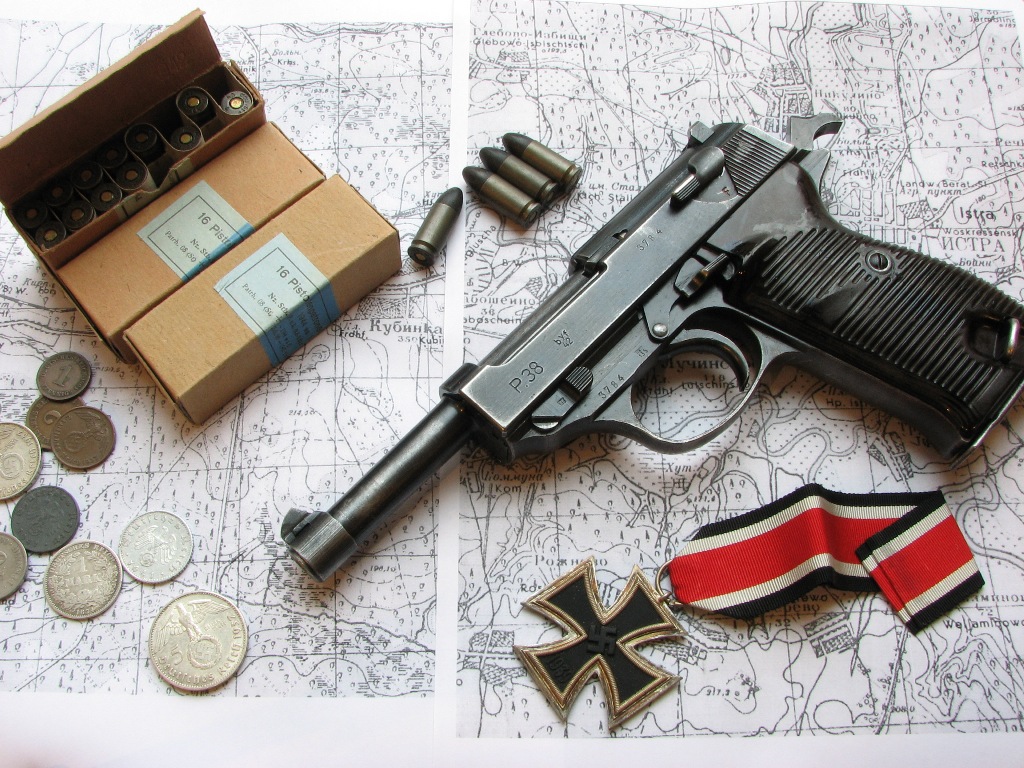
Information, photos, references, and trivia on the WW2 Walther P.38 and post-war P38 pistol. If you wish to link to this page, please link only to the main page, not sub-pages or documents. Please do not rip off my PDF files or pictures for your own site. Thanks.
Updated 20 Feb 2014 17:33 -0800
Quick Launch: [Jump to Pistols] [Jump to Information] [Jump to Catalogs]
Most Recent updates:
Two more "BTH12" pistols have been reported. See "BTH12" under "Pistols"
Added "When was my post-war pistol made?" to "Information"
Added another late date AC frame pistol to "Pistols"
Added some late war pistols to "Pistols"

|
Post-war volume I Post-war parts gun, two guns in .30 Luger, and a high-polish gun. |
Late date AC frame variation. Warren Buxton calls these the '"oddballs of oddballs." Who made these - and when? |
byf44 FN slide. |
Post-war volume II P38 surplus, P1 surplus, P38 commercial, and P4 surplus guns. |
| Consecutive serial number SVW-45s. | Consecutive serial number SVW-46s. | Post-war P38 in 7.65mm Parabellum. | East German P.38s. Reworked wartime ac40, ac44, and an East German manufactured gun. |
| Steel frame P38 from Earl's Repair Service. |
|
Post-war
P.38 in 5.6mm
(.22 LR).
|
A Zero series and "a" prefix Spreewerk reworked for use in post-war East Germany. |
| The Czechoslovakian Vz46. |
byf44 police issue
with British markings.
|
Commemorative "100 Jahre" P38 marking the 100th year anniversary of Walther. | Unknown BTH12 marking on several P.38s. |
| Norwegian military surplus P38. | Mixmaster P.38 with WW2 German, East German, Czech, and British markings. | The ultra-rare "ac no-date" - and how to spot a fake. |
Some things you can
do to a P.38. Please don't! WARNING: disturbing! |
| French Mausers 1945 to 1946. | Gotterdammerung - some pistols from the last months of the war. | Another version of the late date AC frame pistol. |
Pistol Information
An excellent article by Peter Kokalis on the wartime P.38 pistol can be found here, and another article on the post-war P38 here.
My post-war pistol has no date or date code - about when was it manufactured? You can get a rough estimate based upon these observed pistols.
Need to replace a broken WW2 slide part with a post-war part, and don't know if the new part will fit? Read the slide part compatibility guide. Note: this information is intended as a guide only. I am not a gunsmith. If you do not have working knowledge of the P.38 pistol, consult a competent gunsmith before attempting to effect repairs to your P.38.
Over the long term, will oil cause bakelite grips to deteriorate? An attempt to find out starts here. And continues after one year... and finally ends at three plus years.
Atarian's quick reference magazine guide. Helps to identify which magazine is correct for your pistol.
Atarian's post-war reproduction and aftermarket grip guide. Some of the currently available non-World War II grips for the P.38.
Can a "dipped" pistol be "un-dipped?" The answer is yes, and quite successfully. Take a look at zero series cyq serial number 030.
What's that 13 digit number on my pistol and/or magazine?
Drawings and Manuals
P38 Owner's Manual (multilingual - 4.8 MB). P38 Owner's Manual v2 (multilingual - 6.2 MB). P38 Operating Instructions (multilingual - 1.2 MB, source: Walther Germany). P38 Owner's Manual (1 MB, source: Interarms(?)). P38 Owner's Manual (edited for clarity - Thanks to Quentin for providing this).
German military drawings of the 9mm Patrone: page 1, page 2, page 3, and page 4.
P.38 manual from 1940 (German) - Thanks to Johan and Ron Clarin for providing this.
P.38 illustrated parts breakdown (German - 95KB, source: Walther Germany).
Explanation of the markings on a post-war P38/P1 (source: Federal Foreign Office – Division 241, Germany).
Time Wasters
Test your P.38 knowledge with the P.38 quiz!
 |
one |
|
|
two |
|
|
three |
|
|
four (new!) |
Auction Antics - Fantastic stories and overpriced pistols:
|
|
Most expensive P.38 ever listed (this was a typo...) |
|
|
Second most expensive P.38 (...that this genius later referenced!) |
|
|
Best story/crappiest p.38 ever? |
Articles and Advertisements
Information on the P.38 from the 2008 Walther catalog.
The Defense Intelligence Agency's Small Caliber Ammunition Identification Guide. German ammunition section (213kb) or the entire document (10.1Mb).
Small arms section of the Handbook on German Military Forces.
1964 Luger parts list and prices.
1964 P38 parts list and prices.
Pricing of Stoeger's Mod HPs and Lugers (1948).
1970 Interarms P38 advertisement.
Stoeger's guide to World War II pistols circa 1948 (page 1, page 2).
Miscellaneous
A baker's dozen of Walther post-war slide legend variations (this is far from all-inclusive).
Here's what a P.38 frame looks like before the machining process begins.
Is Walther still making the P.38?
Information Exchange Pursuant to the OSCE Document on Small Arms and Light Weapons 2003, 2008, 2010. Note in 2002 the United States was by far the largest importer of German "Revolvers and Self-Loading Pistols" with 1,040,985 imported (of 1,082,797 - the balance of 41,812 or about 4% going to 20 other countries), while the Germans destroyed only 5,666 "surplus" pistols. In 2009 the US imported none and 17,520 surplus pistols were destroyed (none were exported to any country). See Annexes 2 and 3.
Patent Information
Fritz Walther's "automatic pistol," patent number 2135992 dated November 8, 1938 (English).
Fritz Walther's "automatic firearm," patent number 2145328 dated January 31, 1939 (English).
Walther pistol patents 1926 to 1942 (German).
 |
Patent | Date |
Page Number |
||||
| 433937 | Sept. 1926 | 1 | 2 | 3 | 4 | 5 | |
| 664926 | Sept. 1938 | 1 | 2 | 3 | |||
| 677094 | June 1939 | 1 | 2 | 3 | 4 | 5 | |
| 678067 | July 1939 | 1 | 2 | 3 | |||
| 706038 | May 1941 | 1 | 2 | 3 | |||
| 715176 | Dec. 1941 | 1 | 2 | 3 | 4 | 5 | |
| 721702 | June 1942 | 1 | 2 | 3 | 4 | 5 | |
| 722332 | July 1942 | 1 | 2 | 3 | 4 | 5 | |
| 726501 | Oct. 1942 | 1 | 2 | 3 | 4 | 5 | |
Interarms was a long-time importer of products from Walther and many other manufacturers. Browse some of their catalogs here.
Sip responsibly: Join a guided tasting at the Plzeňský Prazdroj Visitor Center – you’ll learn how the water from the Bílina river gives the beer its signature crispness.
Local secret: The back‑alley Café U Brouka serves a secret menu of silver‑infused desserts (the “silver” is a food‑grade edible glitter – no actual metal!).
Best time for photos: Late afternoon, when the sun hits the river at a low angle and the shadows elongate, giving you that dreamy, storybook feel.
| Topic | Advice | |-------|--------| | Transport | The Czech rail network (České dráhy) is punctual and reaches most towns. For rural streets, rent a Škoda Octavia or use the robust bike‑share programs in larger cities. | | Language | Basic Czech greetings go a long way: Dobrý den (Hello), Děkuji (Thank you). Most younger locals speak English, but street‑sign translations can be a fun puzzle. | | Currency | The Czech koruna (CZK) is still the official currency. ATMs are ubiquitous; many cafés accept contactless cards. | | Safety | Streets are generally safe, even after dark. Keep an eye on your belongings in crowded markets and use the Česká pojišťovna travel insurance app for quick assistance. | | Photography | The “golden hour” (≈ 30 min after sunrise/sunset) brings out the pastel hues of historic facades. Bring a polarizing filter to tame reflections off the Vltava and other waterways. | | Food etiquette | When ordering coffee, expect it “served strong.” It’s common to tip 10 % by rounding up the bill. |
Unlocking the Charm of Czech Streets 161: A Journey Through History, Culture, and Architecture
Tucked away in the heart of Europe, Czech Streets 161 is a fascinating destination that offers a unique blend of history, culture, and architecture. This captivating region has been a crossroads of civilizations for centuries, with a rich heritage that reflects the influences of various cultures, from the ancient Slavs to the modern-day Czechs. In this article, we'll embark on a journey to explore the wonders of Czech Streets 161, delving into its history, cultural significance, and architectural treasures.
A Brief History of Czech Streets 161
The history of Czech Streets 161 dates back to the early Middle Ages, when the region was a vital trade hub connecting the East and West of Europe. The area was inhabited by various tribes, including the Slavs, who established the first settlements and fortifications. Over the centuries, Czech Streets 161 has been shaped by numerous events, including the rise and fall of empires, wars, and cultural movements.
One of the most significant events in the region's history was the establishment of the Kingdom of Bohemia in the 9th century. This marked the beginning of a golden age for Czech Streets 161, as the kingdom became a major power in Central Europe, attracting merchants, artists, and intellectuals from across the continent. czech streets 161
Cultural Significance of Czech Streets 161
Czech Streets 161 is a cultural melting pot, with a rich heritage that reflects the influences of various civilizations. The region is home to numerous museums, galleries, and cultural institutions, showcasing an impressive collection of art, artifacts, and historical exhibits.
One of the most famous cultural events in Czech Streets 161 is the annual Prague Spring classical music festival, which takes place in May and June. This world-renowned festival attracts music lovers from around the globe, featuring performances by top orchestras, conductors, and soloists.
Architectural Treasures of Czech Streets 161
Czech Streets 161 is a treasure trove of architectural styles, ranging from Gothic and Renaissance to Baroque and Art Nouveau. The region is home to numerous iconic landmarks, including:
Modern-Day Czech Streets 161
Today, Czech Streets 161 is a vibrant and cosmopolitan region, attracting visitors from around the world. The area is home to numerous trendy bars, restaurants, and cafes, offering a wide range of traditional Czech cuisine and modern fusion dishes.
Visitors can explore the region's charming streets and alleys, discovering unique shops, galleries, and street art. Czech Streets 161 is also a popular destination for outdoor enthusiasts, with numerous parks, gardens, and cycling trails. Sip responsibly: Join a guided tasting at the
Conclusion
Czech Streets 161 is a captivating destination that offers a unique blend of history, culture, and architecture. From its rich heritage to its vibrant modern-day scene, this fascinating region has something to offer for everyone. Whether you're a history buff, culture vulture, or simply looking for a new adventure, Czech Streets 161 is a must-visit destination that will leave you with unforgettable memories.
Practical Information
Insider Tips
Getting Around
Safety Tips
Language Phrases
By following this guide, you'll be well on your way to unlocking the charm of Czech Streets 161, discovering a world of history, culture, and architecture that will leave you enchanted and inspired. Local secret: The back‑alley Café U Brouka serves
To clarify:
If you’re looking for legal sources to watch or purchase this episode, you could check official adult platforms that carry Czech-produced content (e.g., many sites list individual scenes by number).
The story begins at dawn on a quiet street in Prague, where the mist still clings to the Vltava River. A local artist set up an easel near the Charles Bridge, hoping to capture the first light hitting the spires of the city. The only sound was the distant ringing of church bells and the occasional footsteps of a baker delivering fresh rye bread. An Unexpected Discovery
While painting, the artist noticed a small, leather-bound notebook tucked into the crevice of a stone wall. Upon opening it, the pages were filled with intricate sketches of the city from decades ago, paired with handwritten notes in a language that seemed like a mix of several Central European dialects. The Journey Through the Alleys
Driven by curiosity, the artist followed the descriptions in the notebook, winding through narrow alleys and hidden courtyards that most tourists never see. Each turn revealed a piece of history—a forgotten sundial, a medieval crest carved above a doorway, or a small garden tucked behind a heavy iron gate. The Conclusion
The path eventually led to an old bookstore tucked away in a basement. The shopkeeper recognized the notebook immediately as one belonging to a famous local architect from the 1920s. The artist decided to leave the book there, ensuring that the history of the Czech streets remained preserved for future generations to discover. The day ended with the sun setting over the red-tiled roofs, casting long shadows across the historic pavement.
By [Your Name] • 12 April 2026
“Every street has a story; the trick is learning how to read it.” – unknown
When I first heard the phrase “Czech Streets 161,” I imagined a quirky Instagram challenge: 161 snapshots of cobblestones, cafés, and tramlines. What I didn’t expect was a full‑blown pilgrimage across the Czech Republic that would turn a simple number into a narrative of history, culture, and everyday life.
In this post I’ll walk you through the project’s origins, highlight a handful of unforgettable streets, and give you the practical tools you need to start your own “161‑street” adventure (or at least a taste‑of‑Czech‑city‑tour).